Depth Cheat Sheet
What to Fill In
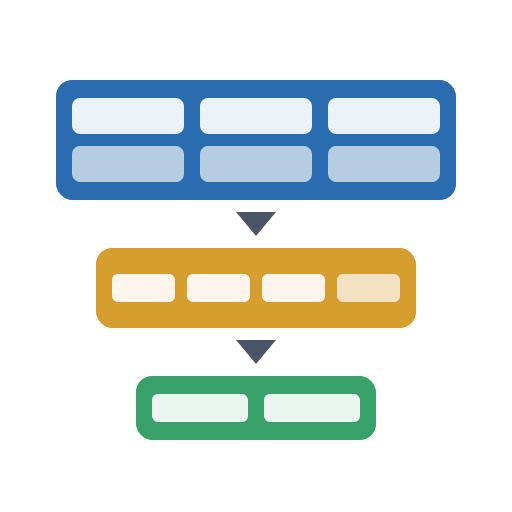
Section titled “What to Fill In”Use this table to see exactly which sections are required at your chosen documentation depth. Pick your column and fill in only the rows marked Yes.
| Section | Minimum | Recommended | Comprehensive |
|---|---|---|---|
| 0. Document Control — title, version, classification, sign-offs | |||
| Document metadata | Yes | Yes | Yes |
| Change history | Yes | Yes | Yes |
| Contributors & approvals | No | Yes | Yes |
| Purpose & scope | Yes | Yes | Yes |
| 1. Executive Summary — what the solution does and why | |||
| Solution overview | Yes | Yes | Yes |
| Business context & drivers | Yes | Yes | Yes |
| Strategic alignment & reuse | No | Yes | Yes |
| Scope (in/out) | Yes | Yes | Yes |
| Current state / As-Is | No | Yes | Yes |
| Key decisions & constraints | Yes | Yes | Yes |
| Project details | No | Yes | Yes |
| Business criticality | No | Yes | Yes |
| 2. Stakeholders — who the design is for and what they care about | |||
| Stakeholder register | Yes | Yes | Yes |
| Concerns matrix | No | Yes | Yes |
| Compliance & regulatory | No | Yes | Yes |
| 3.1 Logical View — components, capabilities, design patterns | |||
| Architecture diagram | Yes | Yes | Yes |
| Component decomposition | Yes | Yes | Yes |
| Design patterns | No | Yes | Yes |
| Service & capability mapping | No | No | Yes |
| Vendor lock-in assessment | No | Yes | Yes |
| 3.2 Integration & Data Flow — how components talk to each other and the outside world | |||
| Data flow diagram | Yes | Yes | Yes |
| Internal connectivity | Yes | Yes | Yes |
| External integrations | Yes | Yes | Yes |
| API & interface contracts | No | Yes | Yes |
| 3.3 Physical View — where it runs (cloud, regions, compute, networks) | |||
| Deployment diagram | Yes | Yes | Yes |
| Hosting & infrastructure | Yes | Yes | Yes |
| Compute | No | Yes | Yes |
| User & admin access | No | Yes | Yes |
| Network connectivity | Yes | Yes | Yes |
| Environments | No | Yes | Yes |
| End user compute & IoT | No | No | Yes |
| 3.4 Data View — what data exists, how it’s classified, where it flows | |||
| Data stores | Yes | Yes | Yes |
| Data classification | Yes | Yes | Yes |
| Data transfers | No | Yes | Yes |
| Data lifecycle | No | No | Yes |
| 3.5 Security View — authentication, authorisation, encryption, monitoring | |||
| Business impact assessment | Yes | Yes | Yes |
| Authentication | Yes | Yes | Yes |
| Authorisation | Yes | Yes | Yes |
| Encryption at rest | Yes | Yes | Yes |
| Secret management | No | Yes | Yes |
| Security monitoring | No | Yes | Yes |
| Threat model | No | No | Yes |
| Network security | No | Yes | Yes |
| 3.6 Scenarios — key use cases and the architecture decisions (ADRs) that shaped the design | |||
| Key use cases | No | Yes | Yes |
| Architecture decision records | No | Yes | Yes |
| 4. Quality Attributes — operability, reliability, performance, cost, sustainability | |||
| Operational excellence | No | Yes | Yes |
| Reliability & resilience | No | Yes | Yes |
| Performance efficiency | No | Yes | Yes |
| Cost optimisation | No | Yes | Yes |
| Sustainability | No | Yes | Yes |
| Quality attribute tradeoffs | No | Yes | Yes |
| 5. Lifecycle — how the solution is built, released, run, and eventually retired | |||
| CI/CD & development | No | Yes | Yes |
| Migration (if applicable) | No | Yes | Yes |
| Test strategy | No | Yes | Yes |
| Release management | No | Yes | Yes |
| Operations & support | No | Yes | Yes |
| Resourcing & skills | No | Yes | Yes |
| Service start | No | No | Yes |
| Maintainability | No | Yes | Yes |
| Decommissioning | No | Yes | Yes |
| Exit planning | No | Yes | Yes |
| 6. Decision Making & Governance — constraints, RAID (risks, assumptions, issues, dependencies), exceptions, sign-off | |||
| Constraints | Yes | Yes | Yes |
| Assumptions | Yes | Yes | Yes |
| Risks | Yes | Yes | Yes |
| Dependencies | Yes | Yes | Yes |
| Issues | No | Yes | Yes |
| Technical debt register | No | Yes | Yes |
| Guardrail exceptions | No | Yes | Yes |
| Architectural decisions log | No | Yes | Yes |
| Compliance traceability | No | No | Yes |
| Approval sign-off | Yes | Yes | Yes |
| 7. Appendices — glossary, references, supporting standards | |||
| Glossary | No | Yes | Yes |
| Reference documents | No | Yes | Yes |
| Standards referenced | No | Yes | Yes |
| Compliance scoring | No | Yes | Yes |
How to Use This Table
Section titled “How to Use This Table”- Choose your depth based on your project’s criticality and governance requirements
- Fill in only the “Yes” rows for your chosen depth
- Skip everything else — do not include empty sections
| Depth | When to Use | Approx. Time | Typical Gate |
|---|---|---|---|
| Minimum | Early-stage designs, proofs of concept, dev/test reviews | 15-30 min | Development review |
| Recommended | Production-bound designs, formal governance | 1-2 hours | Production approval |
| Comprehensive | Critical, regulated, or enterprise-scale systems | 1-2 days | Enterprise architecture review |
Time estimates assume you already understand the solution and are drafting solo. Add 50–100% for collaborative drafting, and again for diagrams that need polishing for an external audience. Comprehensive timings include threat modelling, capacity planning, and full traceability — not just typing.